Aortic Aneurysm Repair Austin Texas | Aneurysm Specialists
Definition of Aortic Aneursyms
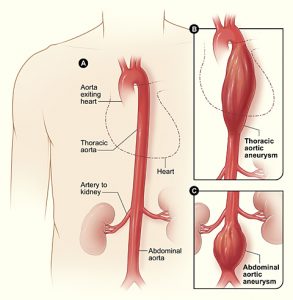
Aorta aneursyms, also referred to as Aortic Aneurysms, are a common blood vessel abnormality. An aneurysm is a permanent and irreversible dilatation of an artery by at least fifty percent of its normal diameter. For the aorta, an aneurysm would be classified as enlargement of the vessel over 3 cm in diameter. This dilation and enlargement of the blood vessel wall leads to degradation and weakness of the vessel wall that caused the vessel to dilate like a balloon at the area of weakness. When the wall of the blood vessel weakens and thins too much, then the vessel can rupture. Rupture usually leads to rapid and massive blood loss, resulting in death. In the United States, aortic aneurysm rupture is the 15th leading cause of death in adults. Aortic aneurysm repair prevents these lethal events.
Location of Aortic Aneurysms
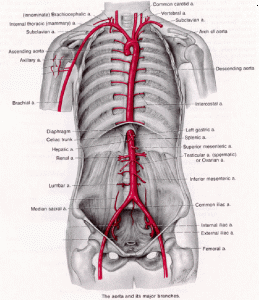
The aorta is the largest blood vessel in body. The aorta starts at the level of the heart, referred to as the aortic root. The base of the aortic root begins at the aortic valve of the heart that controls blood flow leaving the heart muscle pump. The aorta then extends into the central chest at the aortic arch, shaped like the top of a walking cane. The aorta then descends through the chest and towards the abdomen (i.e. the descending aorta). The portion of the aorta that is present in the chest is referred to as the thoracic aorta. Once the aorta leaves the chest and crosses into the abdomen, then it is referred to as the abdominal aorta. The transition point from the chest cavity into the abdominal cavity is defined by the diaphragm muscle, which is the breathing muscle.
The abdominal aorta is the most common location for aorta aneurysms to develop. The vast majority of these aortic aneurysm occur below the kidney arteries (referred to as the renal arteries).
Risk Factors For Aneurysm Formation
Family history of aneurysms, history of tobacco smoking, advanced age, male sex, chronic hypertension, hardening of the arteries / atherosclerosis, trauma, inflammatory diseases suach as Takayasu’s disease, arteritis, infections, connective tissue disorders, and chronic obstructive pulmonary disease (COPD). The majority of people who develop aortic aneurysms have a history of tobacco smoking. But there are also many non-smokers that develop aneurysms as well.
Symptoms Of Aortic Aneurysms
Aortic aneurysms usually are asymptomatic and are most commonly noticed incidentally on imaging studies done for other reason. CT scans or MRI scans for workup of unrelated problems is the most common imaging modalities that discover aortic aneurysms. Since some aneurysms contain calcium that can be visualzied on plain x-ray films, some aortic aneursyms are also discoverd when chest x-rays or abdominal x-rays are performed for other reasons.
When aortic aneurysms do cause symptoms, it is most commonly because the aneurysm has ruptured. Ruptured aneurysms often lead to immediate death. But some “contained” ruptures will lead to abdominal, pelvic, or back pain that is typically sudden in onset and severe in nature. If these contained ruptures are treated very quickly then a successful outcome can be achieved.
Another reason that an aortic aneurysm can cause pain is if they are inflamed (inflammatory aneurysms) or if a dissection occurs within an aneurysm. Both of these situations require immediate evaluation by a healthcare provider.
Treatment of Aortic Aneurysms – Aortic Aneurysm Repair
Aortic aneurysms can be closely monitored by imaging studies when they are below a certain size, are slow-growing, and when they are not felt to be at risk of rupture. Fusiform abdominal aortic aneurysms (the most common type of aortic aneurysm) typically undergo aortic aneurysm repair if they have reached a size of over 5.5 cm or if they are growing more than 1 cm per year of show sudden increase in size. Aneurysms associated with pain should also be considered for repair.
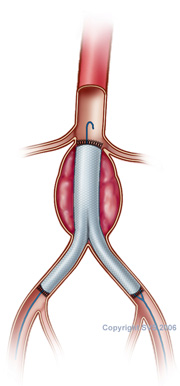
The most common ways to repair an aortic aneurysms is either with a stent-graft or with open surgery of the abdomen and / or the chest. Stent-grafts are typically inserted through groin access with catheters and sheaths, so this method is less invasive. Open traditional surgery typically requires a large incision on the abdomen and / or the chest. Which method is utilized if often determined by the location of the aneurysm and whether it is attached to other major blood vessels. Aortic aneurysm repair with stent-grafts have become the most common method of repair. A CT scan is the most common way to determine if a stent-graft can be a successful method of repair.
Other determining factors of whether to perform aortic aneurysm repair with a stent-graft or open surgery is the age of the patient and the other medical problems that the patient currently exhibits. Younger patients may be more likely to be offered open surgery due to the longer durability of open surgical repairs. Patients suffering from other major health issues that are serious or life-threatening may be more likely to be offered a stent-graft if they are felt to be unlikely to recover well from a major open surgery.
Vascular Surgeons & Aortic Aneurysm Repair
Vascular Surgeons are uniquely qualified to treat aortic aneurysm due to their ability to treat these aneurysms with both methods of repair (open surgery and stent-graft repair). Other doctors that are not vascular surgeons but yet perform aneurysm procedures are typically trained in only one method of treatment but no the other (they are able to do EITHER open surgery OR stent-grafts, but not both).
The reasons that it is important that your aneurysm surgeon is trained in both methods of repair is a critical issue. What if a doctor is attempting to perform an aortic aneurysm repair with a stent-graft but is unable to successfully complete the procedure or worse yet injures the aneurysm during the attempt and serious bleeding starts to occur. In these situations the repair will immediately need to be converted to an open surgery in order to have the best chance of survival. A vascular surgeon is most readily trained and experienced to cope with these situations. A doctor that is not trained, qualified, or credentialed to do the open surgery will not be able to successfully convert a failed stent-graft repair to a successful open surgery.
Another situation that can occur is that a patient be offered only a stent-graft or only an open surgery if the physician is not able to perform the other type of procedure. If the patient meets with a vascular surgeon that can perform both open aneurysm surgery as well as stent-graft repair of aneurysms, then the doctor can be offered the both of the options to the patient when appropriate, weighing the pros and cons of each. This allows greater choice and broader counseling. Only vascular surgeons are residency and fellowship trained in both open abdominal aortic aneurysm repair as well as endovascular stent-graft repair. And it is the strong opinion of the Society of Vascular Surgery in the United States that vascular surgeons and cardiothoracic surgeons are the best qualified specialists to be treating aortic aneurysms due to their unique training and experience in both open aneurysm surgery and endovascular stent-graft repair of aneurysms.